01
AI System Inventory
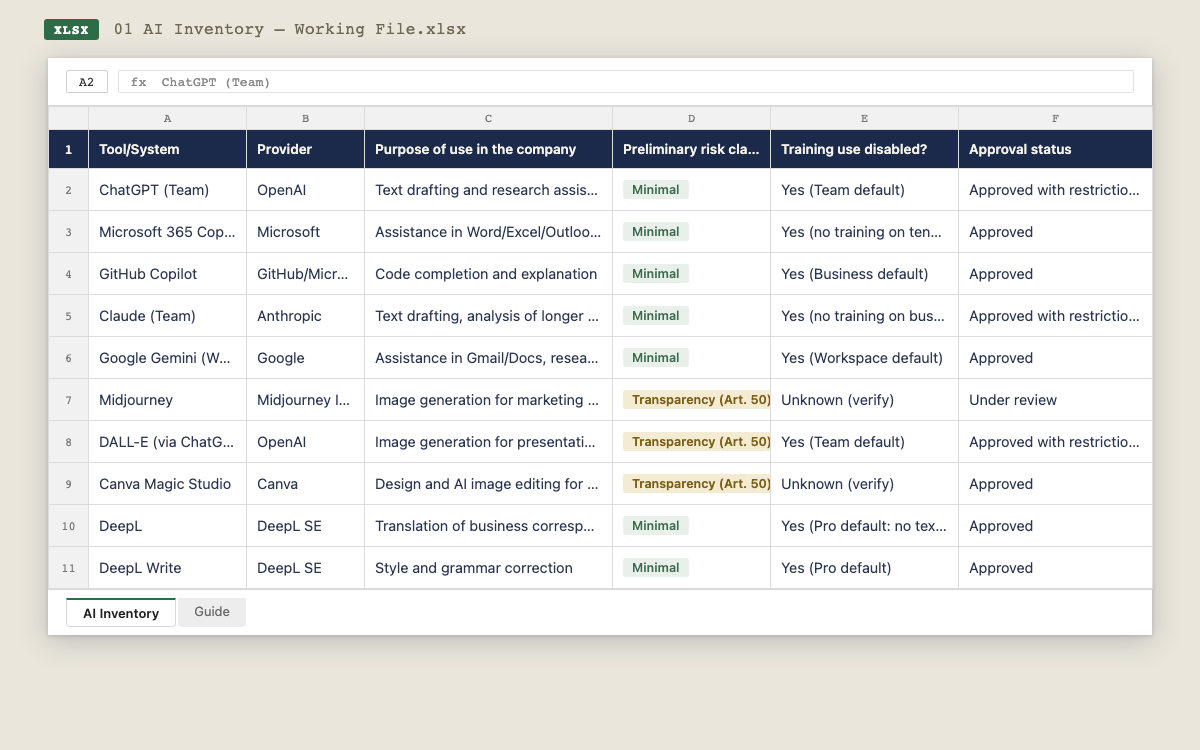
Pre-filled with 30 tools your team already uses — ChatGPT, Copilot, Midjourney, DeepL — including provider/deployer role columns, plus a step-by-step guide.
XLSXDOCX
EU AI Act · Regulation (EU) 2024/1689 · Legal status: June 2026
The high-risk deadline is moving to December 2027 — politically agreed, formal adoption pending. But the Art. 50 transparency duties arrive on 2 August 2026 unchanged (chatbot disclosure, deepfake labelling), and the AI-literacy duty of Art. 4 has applied since February 2025. This kit shows what actually applies — and what doesn’t.
Free classifier · no signup · your answers never leave your browser
01 — The real timeline
Most guides online still show the pre-Omnibus schedule. This is the actual state of play as of June 2026 — the same timeline our kit is built on.
Already law for every company using AI. Emotion recognition towards your own employees is banned. Art. 4 requires staff training “to the best of your ability” — no direct EU fine, but your liability shield.
Duties for providers of general-purpose models. Legacy models have until 2 Aug 2027. Mostly your vendors’ problem — but worth asking about (Module 06).
Not postponed by the Omnibus. Chatbots must be recognisable as AI, deepfakes and AI text on matters of public interest must be labelled — and national market-surveillance authorities go live the same day, with a formal complaint right for anyone (Art. 85). This is the deadline that touches almost every SME with a chatbot or AI content.
Postponement politically agreed in trilogue on 7 May 2026; committees approved on 2 June 2026 (93:4:15). Until it is published in the Official Journal, the law formally still says 2 Aug 2026 — so plan with lead time, don’t plan to zero.
AI as a safety component of machinery, medical devices and other regulated products — relevant for manufacturers.
Sources: EUR-Lex, Regulation (EU) 2024/1689 · Council of the EU press release, 7 May 2026 · IMCO/LIBE vote, 2 June 2026. We re-verify before every kit update — and ship free updates until the Official Journal version lands.
02 — What’s in the kit
Everything in English and German, as Word, Excel and PowerPoint files you adapt to your company — built for deployers of everyday AI tools, verified against the regulation text.
Pre-filled with 30 tools your team already uses — ChatGPT, Copilot, Midjourney, DeepL — including provider/deployer role columns, plus a step-by-step guide.
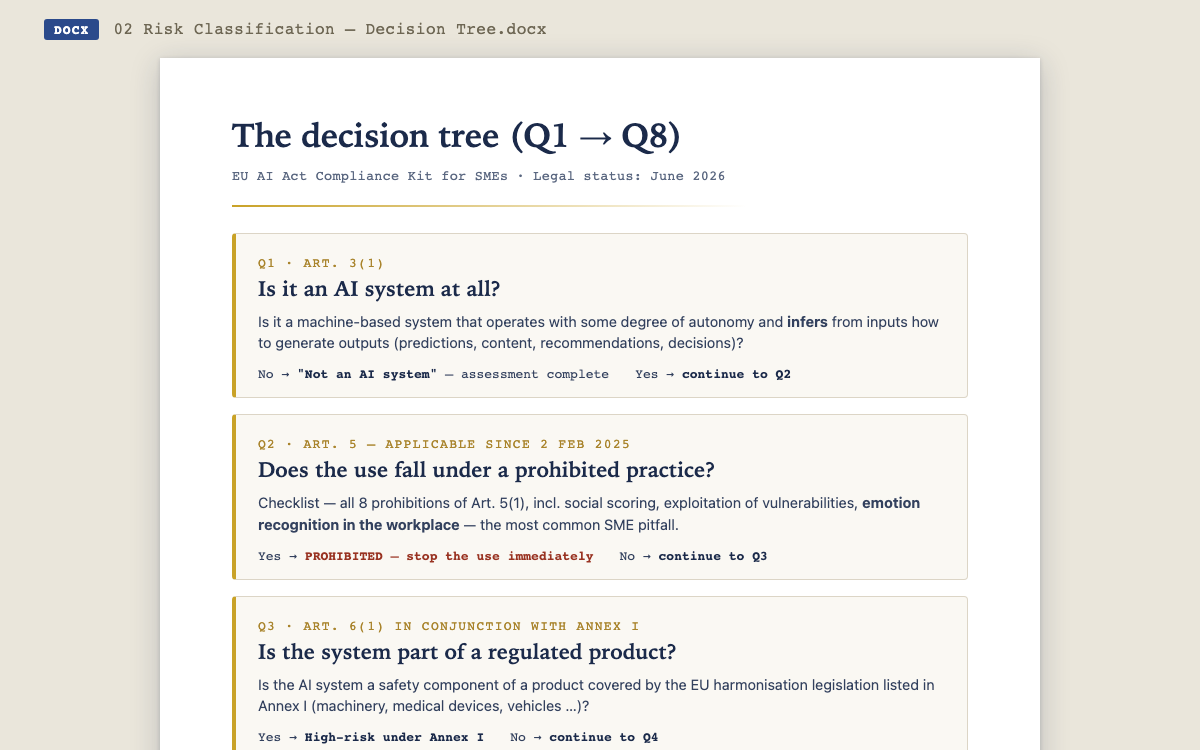
The Q1–Q8 tree behind the free classifier, with six worked real-world examples and an audit-proof documentation template.
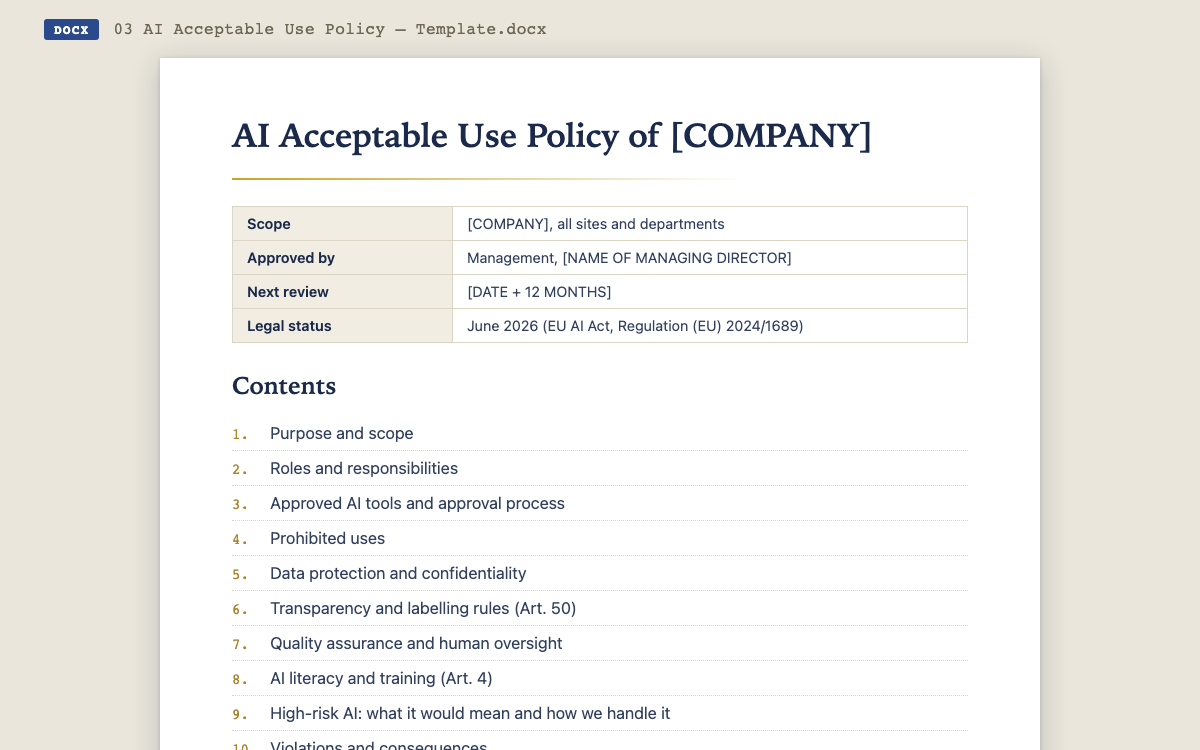
An adaptable company policy: permitted tools, prohibited inputs, review duties — plus ready-made Art. 50 wording blocks for chatbots and AI content.
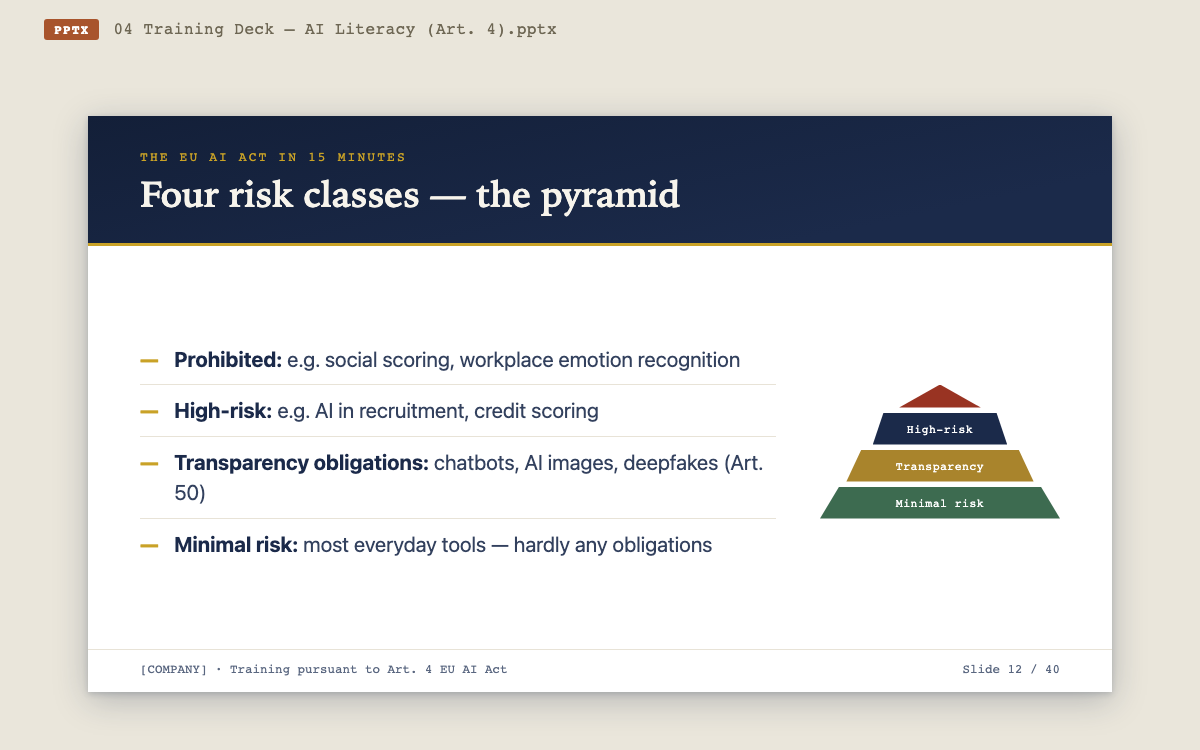
A 40-slide AI-literacy training you can present as-is: how the tools work, what may go into prompts, what must be checked.
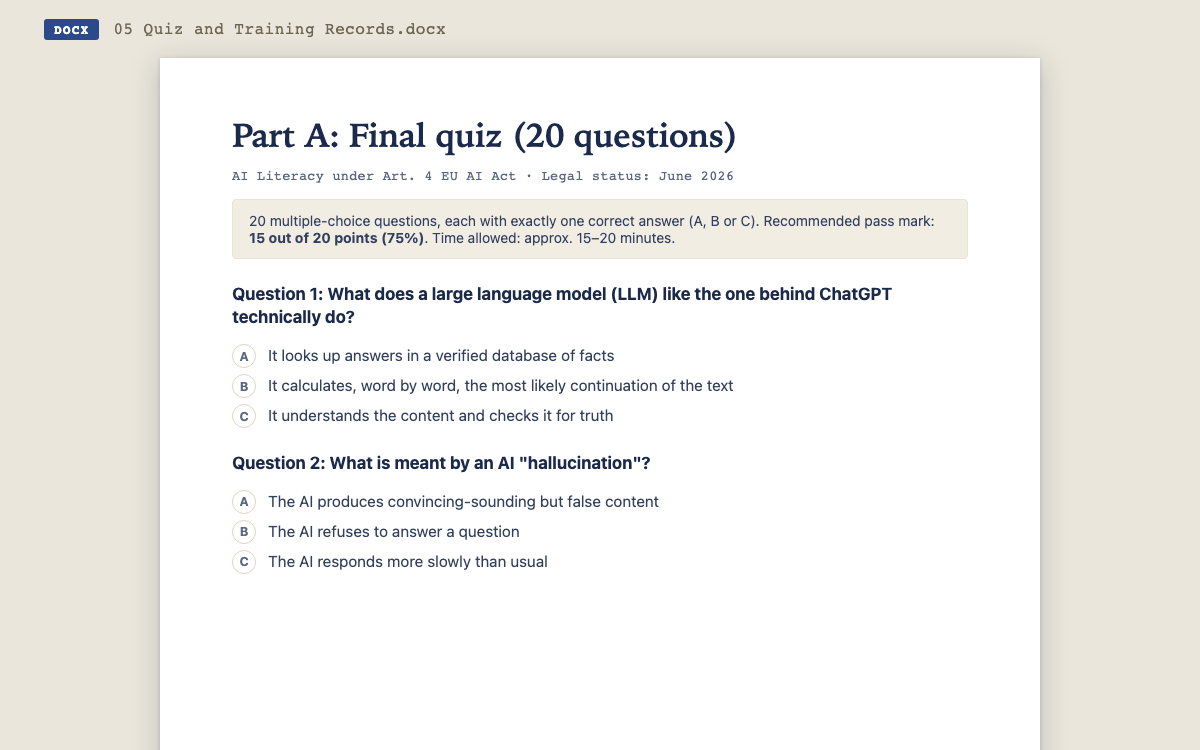
A 20-question quiz, attendance record and participation certificate — the paper trail that turns “we did a training” into evidence.
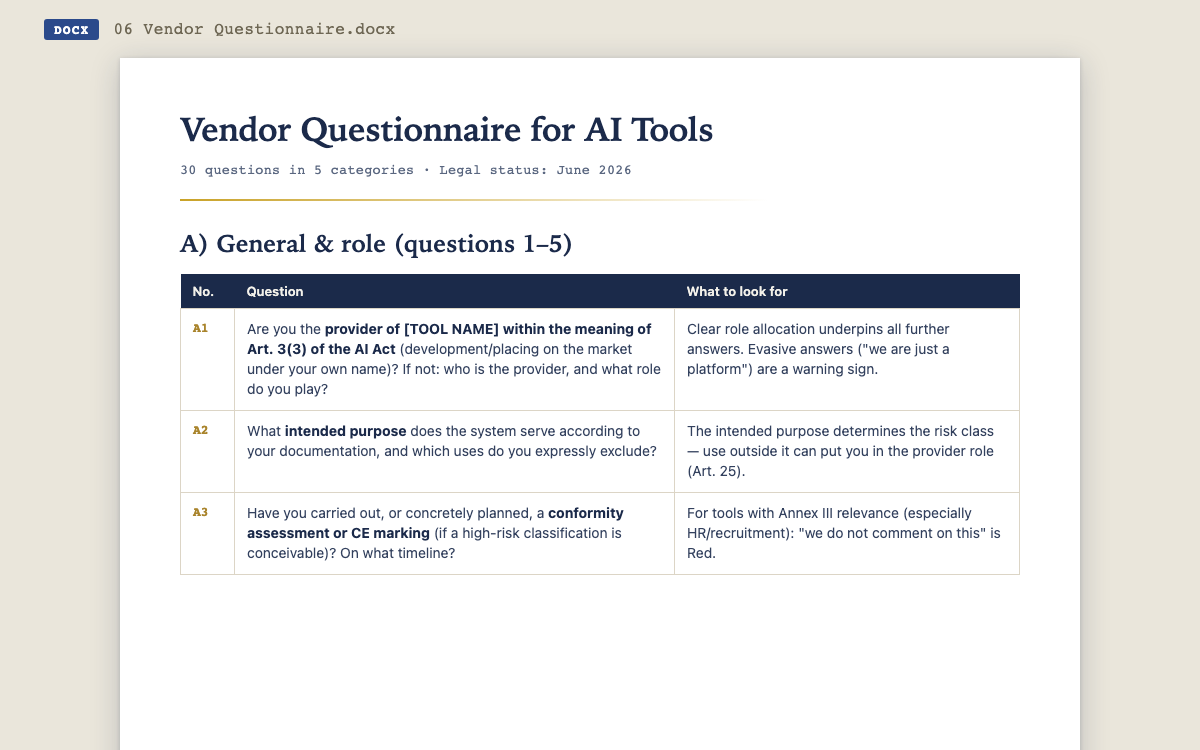
The questions your AI suppliers must answer before you sign: conformity, registration, Art. 50 marking, Art. 6(3) reasoning.
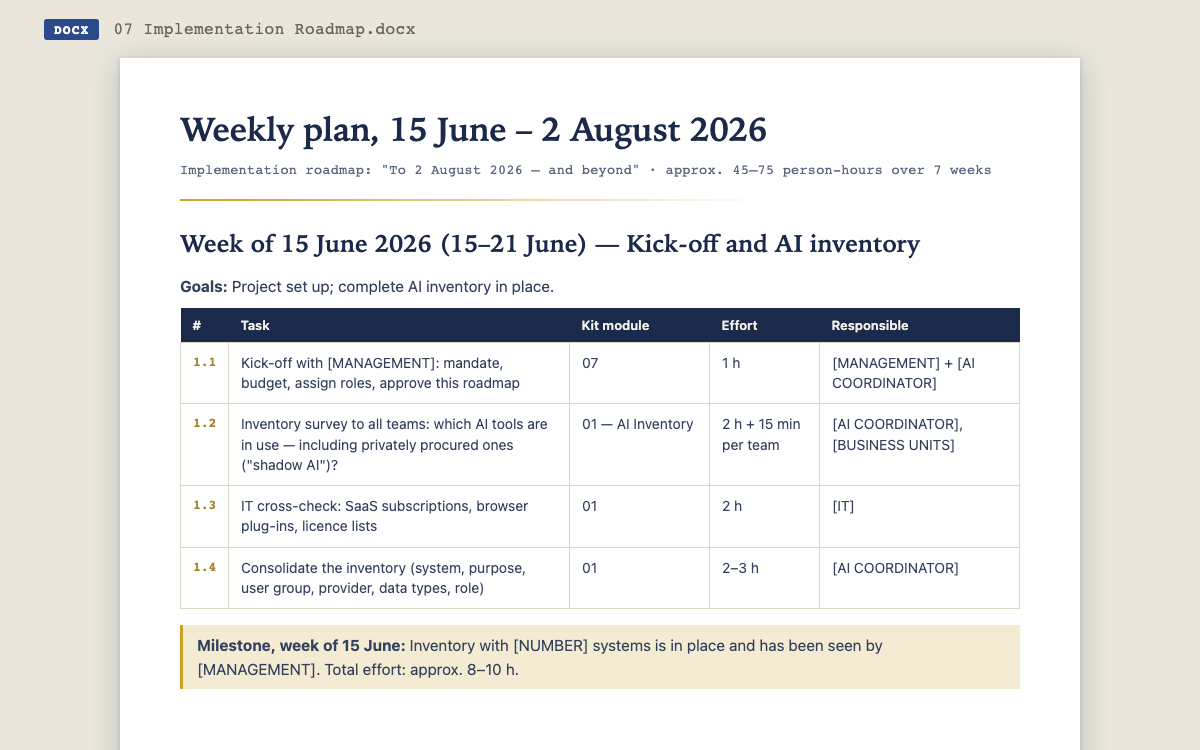
Week-by-week plan to the 2 Aug 2026 deadline, plus the 2027 high-risk outlook and an Official-Journal watchlist.
03 — An honest fit check
We mean it: if your AI system can decide who gets hired, insured or arrested, a €49 kit is not your answer. For everyone deploying everyday AI tools, it most likely is.
04 — Pricing
Checkout and invoicing via Gumroad (merchant of record) — VAT is calculated and handled automatically at checkout, wherever in the EU you are. Instant download after payment.
05 — Questions, answered straight
No. The kit is a carefully researched working aid — every claim is verified against the regulation text and the official Omnibus documents, with the legal status (June 2026) printed on every module. It does not replace a lawyer for binding questions, and we say so on every page rather than in fine print.
Politically agreed on 7 May 2026: high-risk obligations for Annex III systems move from 2 Aug 2026 to 2 Dec 2027 (Annex I products: to 2 Aug 2028). What it does not change: the Art. 5 prohibitions, Art. 4 AI literacy, and the Art. 50 transparency duties arriving 2 Aug 2026. Formal adoption is pending — until publication in the Official Journal, the old dates formally remain law. The kit covers both states and tells you which to plan for.
If you use AI at all, Art. 4 has applied to you since February 2025, and if you run a chatbot or publish AI content, Art. 50 hits you on 2 Aug 2026 — company size doesn’t exempt you (it only lowers the fine caps, Art. 99(6)). The honest answer: you need about an afternoon with the kit, not a compliance department. Start with the free classifier; if everything comes back “minimal risk”, the training module alone may be all you need.
Three reasons. First, the duties that hit nearly everyone (Art. 50) come on 2 Aug 2026 — unchanged. Second, the postponement is politically agreed but not yet in the Official Journal; until then, 2 Aug 2026 formally remains the high-risk date. Third, market surveillance starts in August 2026 with a public complaint right — a competitor or ex-employee can file against you from day one.
Free updates at least until the Digital Omnibus is published in the Official Journal and the kit reflects the final wording. You’ll get update notifications through Gumroad and can re-download anytime. The legal status date is printed on every module so you always know what you’re holding.
Both tiers include every module in English and German — including both language versions of the training deck and the policy. Buy once, roll out across EU teams.
Purchases run through Gumroad, and refunds are handled there: if the kit isn’t useful to you, reply to your receipt within 14 days and you’ll get your money back. No forms, no “exit interview”.
Yes — no signup, no email gate, no cookies. It runs entirely in your browser; your answers never leave your device. It implements the same Q1–Q8 decision tree as Module 02 of the kit.
Start with the free classifier — it tells you exactly which obligations apply to each tool you use, with the real deadlines.